

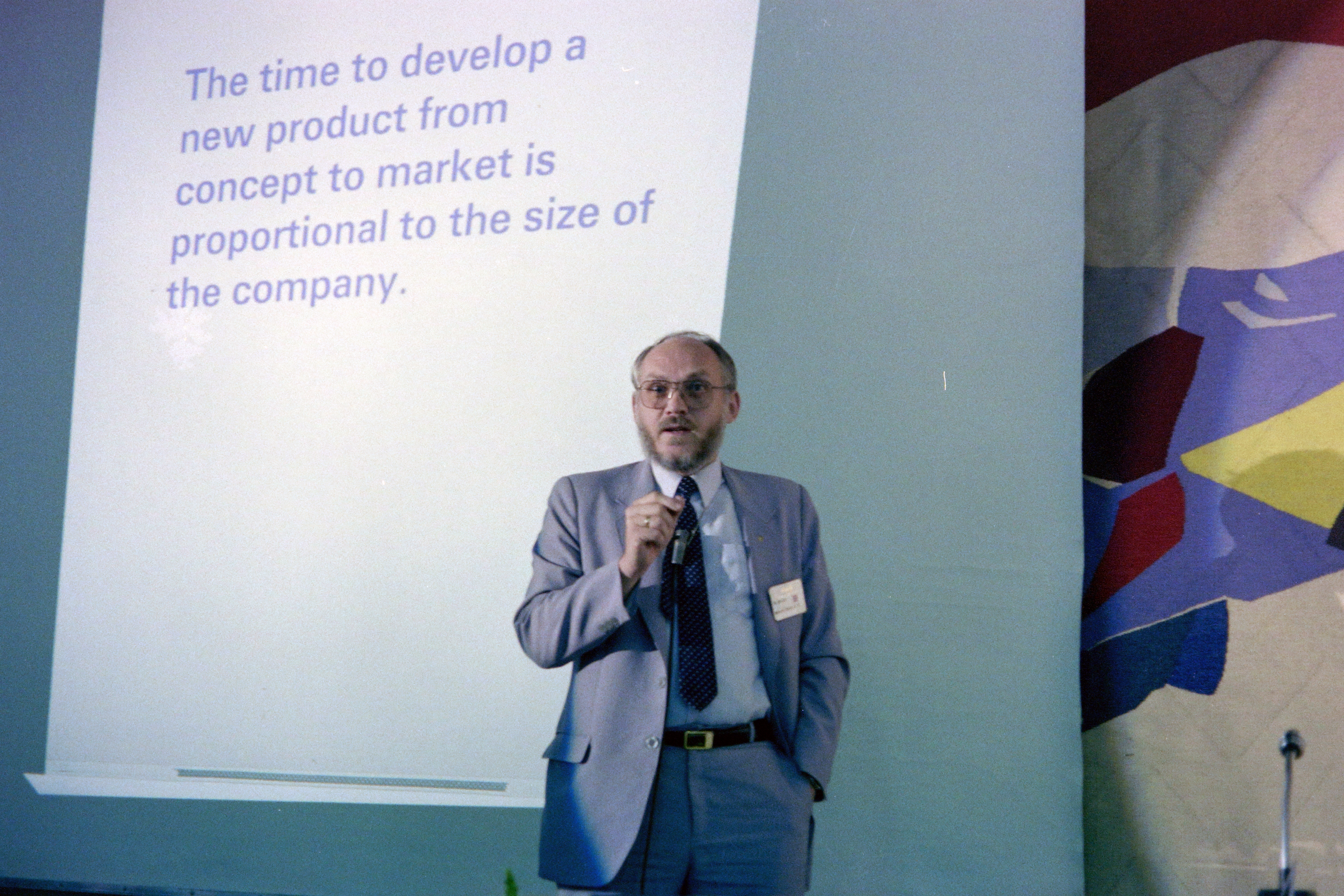
- (b.) 1941 May 13 - (d.) 2023 May 24
Bio/Description
Researcher on the second minicomputer in the world based on integrated circuits, Skår was also a co-founder of Norsk Data and served as CEO of the Norwegian Space Centre from 1997 to 2006.
A Norwegian engineer, Skår was born in Karmøy in 1941 and grew up on a small farm in Rogaland. At the age of 13, he decided to study to become a civil engineer. He graduated from high school in Haugesund in 1960. Four years of study in low power and control engineering from the Norwegian Institute of Technology (NTH) was supplemented with summer jobs abroad.
In the summer of 1965 he married and worked as a programmer for NATO in La Spezia, Italy. He studied under Professor Jens Rate Glad Balchen, who influenced him both professionally in computer technology and personally. His studies were completed with a diploma in 1966, where he completed the draft by the Norwegian Defence Research Establishment (FFI). The task was to develop an application system on digit group self-built computer SAM. His responsibility was for the software project SAM 2, which was launched under the leadership of Per Bjorge.
After he completed military service he received a research position at FFI. After several months, work on SAM 2 was completed in April 1967 as the second minicomputer in the world based on integrated circuits (the first was the Apollo guidance computer). Skår was an engineer in Engineering Cybernetics at the Norwegian Institute of Technology in 1966 and came quickly into the early development of computers in Norway. He was a co-founder of the computer manufacturing company Norsk Data in 1967, which produced minicomputers and software, and he served as CEO of the company from 1978 to 1989.
Skår was quoted as saying, "One of the things I'm most proud of for my time in Norwegian Data is the important contract with CERN in 1972." The contract saved Norwegian Data from bankruptcy and laid the foundation for the growth that followed for 14 years with 40% growth each year. In 1987 the company had a turnover of 2.8 billion and had more than 4,000 employees in Norway and abroad.
In the 1990s, he served as Managing Director of the Norwegian Science Research before joining Norconsult International as Managing Director. In NTNF he made major changes and introduced user-driven research as a new tool. He went on to another part of the Norwegian environmental technology sector when he became Chairman of the Norwegian Space Centre in 1993. Five years later he was appointed Managing Director, and Skår served as CEO of the Norwegian Space Centre from 1997 to 2006.
He worked at the Norwegian Space Centre with an emphasis on industrial development and exploitation of Norway's geographical advantage to build a national infrastructure. Also in this context he showed himself as an entrepreneur with a flair for technological innovations. Skår was instrumental in the creation of Kongsberg Satellite Services A/S and the restructuring of the satellite business in Tromsø and Svalbard. He was also instrumental in establishing the fiber optic cable that connects Svalbard to mainland Norway. The fiber was put in place because he saw an opportunity for cooperation with U.S. NASA and NOAA, as well as a much more cost-effective data transfer capacity for Svalbard.
Subsequently, he held two engagements with the European Space Agency: he served as ESA's Ombudsman, a kind of mediator between industrial companies that had contracts with ESA, and he chaired a working group to recommend how ESA should develop its own centers and infrastructure. Skår was a member of the Norwegian Academy of Technological Sciences, Kungl. Engineering Sciences in Sweden, and the International Academy of Aeronautics.
Citations:
-
Date of Birth:
1941 May 13 -
Date of Death:
2023 May 24 -
Gender:
Male -
Noted For:
Researcher on the second minicomputer in the world based on integrated circuits (the first was the Apollo guidance computer) and was CEO of the Norwegian Space Centre from 1997 to 2006 -
Category of Achievement: