
Stephen Wolfram

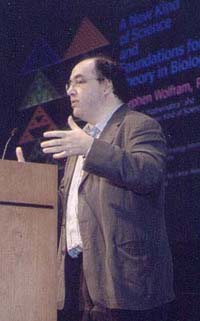
- (b.) 1959 August 29
Bio/Description
Chief designer of Mathematica and the Wolfram Alpha computational knowledge engine, Wolfram is a British scientist whose parents were Jewish refugees who emigrated from Westphalia, Germany, to England in 1933. He was educated at Eton, where he amazed and frustrated teachers by his brilliance and refusal to be taught; instead he did other students' math homework for money. He published an article on particle physics, but claimed to be bored and left Eton prematurely in 1976.
He entered St John's College, Oxford at age 17, but found lectures "awful"; working independently, he published a widely cited paper on heavy quark production at age 18 and nine other papers, before leaving in 1978 without graduating. Wolfram received a Ph.D. in particle physics from the California Institute of Technology at age 20, joined the faculty there, and received one of the first MacArthur awards in 1981, at age 21. His work with Geoffrey Fox on the theory of the strong interaction is still used today in experimental particle physics.
He led the development of the computer algebra system SMP (Symbolic Manipulation Program) in the Caltech physics department during 1979–1981. A dispute with the administration over the intellectual property rights regarding SMP—patents, copyright, and faculty involvement in commercial ventures—eventually caused him to resign from Caltech. SMP was further developed and marketed commercially by Inference Corp. of Los Angeles during 1983–1988. He founded the journal Complex Systems in 1987.
In 1983, Wolfram left for the School of Natural Sciences of the Institute for Advanced Study, where he studied cellular automata, mainly with computer simulations. He produced a series of papers systematically investigating the class of elementary cellular automata, conceiving the Wolfram code, a naming system for one-dimensional cellular automata, and a classification scheme for the complexity of their behavior. He conjectured that the Rule 110 cellular automaton may be Turing complete. In the middle 1980s, he worked on simulations of physical processes (such as turbulent fluid flow) with cellular automata on the Connection Machine alongside Richard Feynman.
In 1986 he left the Institute for Advanced Study for the University of Illinois at Urbana-Champaign, where he founded their Center for Complex Systems Research and started to develop the computer algebra system Mathematica, which was first released in 1988, when he left academia. In 1987 he co-founded a company called Wolfram Research, which continued to develop and market the program.
From 1992 to 2002, Wolfram worked on his controversial book, "A New Kind of Science", which presents an empirical study of very simple computational systems. Additionally, it argues that for fundamental reasons these types of systems, rather than traditional mathematics, are needed to model and understand complexity in nature. His conclusion is that the universe is digital in its nature, and runs on fundamental laws which can be described as simple programs. He predicted that a realization of this within the scientific communities would have a major and revolutionary influence on physics, chemistry, and biology and the majority of scientific areas in general, which is the reason for the book's title.
Following the release of the book in 2002, he split his time between developing Mathematica and encouraging people to get involved with the subject matter of "A New Kind of Science" by giving talks, holding conferences, and starting a summer school devoted to the topic. In March 2009, he announced Wolfram Alpha.
Citations:
-
Date of Birth:
1959 August 29 -
Gender:
Male -
Noted For:
Chief designer of the Mathematica software application and the Wolfram Alpha computational knowledge engine