
Klaus Schulten

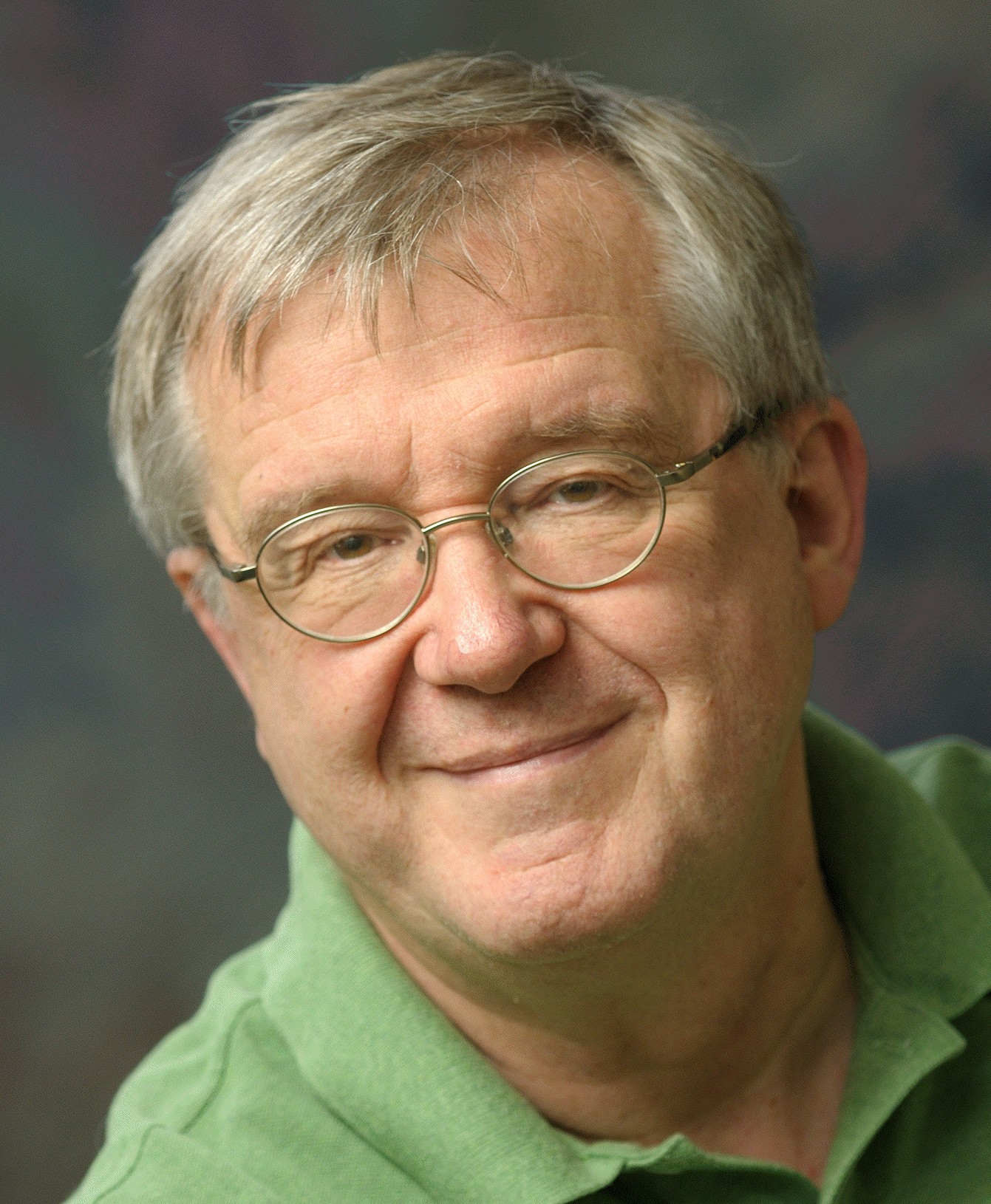
- (b.) 1947 January 12 - (d.) 2016 October 31
Bio/Description
Leader of the research group that developed NAMD and VMD—molecular dynamics and visualization software now used by many thousands of researchers worldwide—Schulten was a German American computational biophysicist and the Swanlund Professor of Physics at the University of Illinois at Urbana-Champaign, where he directed the NIH Biotechnology Research Center on Macromolecular Modeling and co-directed the NSF Physics Frontier Center on Living Cell Physics. His research group was well known for the development of software for computational structural biology, including the molecular dynamics package NAMD (jointly developed with colleague Professor Laxmikant Kale) and the visualization software VMD. NAMD (NAnoscale Molecular Dynamics program) is a freeware molecular dynamics simulation package written using the Charm++ parallel programming model, noted for its parallel efficiency and often used to simulate large systems (millions of atoms).
The early development of NAMD at UIUC grew out of efforts by his students in Munich to build a custom parallel computer optimized for molecular dynamics simulations. His later work concentrated on molecular modeling using graphical processing units (GPUs), particularly using molecular dynamics in combination with cryo-electron microscopy to study the structures of large macromolecular complexes. The molecular dynamics and structure analysis programs NAMD and VMD, born and continuously developed in his group, came to be used by many thousands of researchers worldwide. In 2013, Schulten's group published a simulated structure of the human immunodeficiency virus capsid containing 64 million atoms—among the largest simulations reported—produced using the supercomputer Blue Waters.
He received the Diplom degree from the University of Muenster in 1969 and his Ph.D. in Chemical Physics from Harvard University in 1974, advised by Martin Karplus. After graduating, Schulten joined the Max Planck Institute for Biophysical Chemistry, where he remained until 1980. He then became a professor of Theoretical Physics at the Technical University of Munich, where he advised notable biophysicist Axel Brunger as a Ph.D. student. In 1988, he moved to the University of Illinois at Urbana-Champaign (UIUC), where he was a member of the Beckman Institute and a founding member of the Theoretical and Computational Biophysics Group.
Schulten was a Fellow of the Biophysical Society (2012) and of the American Physical Society (1993). Along with Professor Laxmikant (Sanjay) Kale, he received the 2012 Sidney Fernbach Joint Award from the IEEE Computer Society, "For outstanding contributions to the development of widely used parallel software for large biomolecular systems simulation." He also received the Biophysical Society Distinguished Service Award in 2013.
As of 2013, his work in biological physics had produced over 650 publications, which had been cited over 75,000 times (Google Scholar) as of February 2015. Schulten believed strongly in the importance of educating the next generation of scientists, having graduated 80 Ph.D. students, many of whom went on to distinguished academic positions. He developed new courses and textbooks, and organized a popular series of hands-on training workshops in which he trained, in small groups, over 1,000 young scientists.
Citations:
-
Date of Birth:
1947 January 12 -
Date of Death:
2016 October 31 -
Gender:
Male -
Noted For:
Leader of the research group that developed the software for computational structural biology, including the molecular dynamics package NAMD and the visualization software VMD used today by many thousands of researchers worldwide -
Category of Achievement: